If your healthcare provider has ordered an MRI, you may be wondering how to prepare, how long the scan will take and when you will get answers. Understanding the process can help you plan your visit and feel more comfortable during the examination.
At Advanced Diagnostic Radiology in Cumberland, Maryland, our team provides diagnostic imaging to support your referring provider’s evaluation and treatment planning.
This guide brings together the questions patients commonly ask before their first MRI, including how it compares with CT and X-rays.
How Does an MRI Work
Magnetic resonance imaging uses a strong magnetic field, radio waves and a computer to create detailed pictures of structures inside your body. Unlike CT scans and conventional X-rays, MRI does not use ionizing radiation. The scan captures images in sequences that allow a radiologist to examine the area from different perspectives.
Your provider orders a specific examination based on your symptoms and the clinical question. Some exams include an injection of contrast material to make selected tissues or abnormalities easier to see. You can explore our MRI services in Cumberland for an overview of the examination.
What Can an MRI Help Detect
MRI is particularly useful for evaluating soft tissues. Depending on the body area and imaging protocol, it may help investigate:
- Brain and spinal cord conditions, including certain tumors, inflammation and neurological abnormalities.
- Joint and sports injuries involving ligaments, tendons, cartilage and muscles.
- Spinal disc changes and other abnormalities that may affect nearby nerves.
- Selected organ abnormalities and changes that may require additional evaluation.
For example, RadiologyInfo’s brain MRI guide explains how the test can help investigate a range of neurological conditions.
An MRI does not answer every diagnostic question on its own. Your provider considers the findings alongside your symptoms, examination, medical history and other test results.
MRI Compared With CT Scans and X Rays
These imaging tests serve different purposes. The right choice depends on the suspected condition, how quickly images are needed and whether there are safety considerations.
X-rays are often an initial test for a suspected fracture or certain joint and chest problems. They use ionizing radiation and provide less soft-tissue detail than MRI for many musculoskeletal questions. Johns Hopkins Medicine’s explanation of X-rays describes their role in examining bones and other structures. If an X-ray does not explain persistent symptoms, your provider may consider further imaging; an MRI is not automatically needed.
CT uses X-rays taken from multiple angles to produce cross-sectional images. It is often faster than MRI and can be valuable for evaluating injuries, internal bleeding, lungs and bones. Cleveland Clinic’s CT scan overview explains the technology and its uses.
MRI can provide greater detail for many soft-tissue questions, but usually takes longer. Your provider may choose it to assess a ligament injury, spinal disc problem or certain brain abnormalities. ADR also offers CT scans and digital X-rays, allowing the examination to be matched to the information your provider needs.
How to Prepare for Your MRI
Follow the instructions for your specific appointment. Preparation varies with the body part, use of contrast and whether medication is planned to help you relax. Before your visit:
Report implants and metal. Tell the team about pacemakers, stimulators, cochlear implants, surgical clips, metal fragments and other devices. Bring your device identification card if available so the team can check the exact model and scanning conditions.
Discuss relevant health history. Mention kidney disease, previous contrast reactions, recent surgery and any possibility of pregnancy. The team will determine whether further assessment is needed.
Confirm food and medication instructions. Do not assume you must fast or stop medication. Ask what applies to your ordered examination.
Plan for clothing and belongings. Expect to remove jewelry, watches, hearing aids and other items as directed, and to change into a gown when requested.
Bring requested records. Ask whether you need your imaging order, prior images, insurance card or other documents.
Having an implant does not automatically rule out MRI, but it must be screened before you enter the scanning area. RadiologyInfo’s MRI safety guidance explains why careful screening matters even though the test does not use X-rays.
What Happens During an MRI Scan
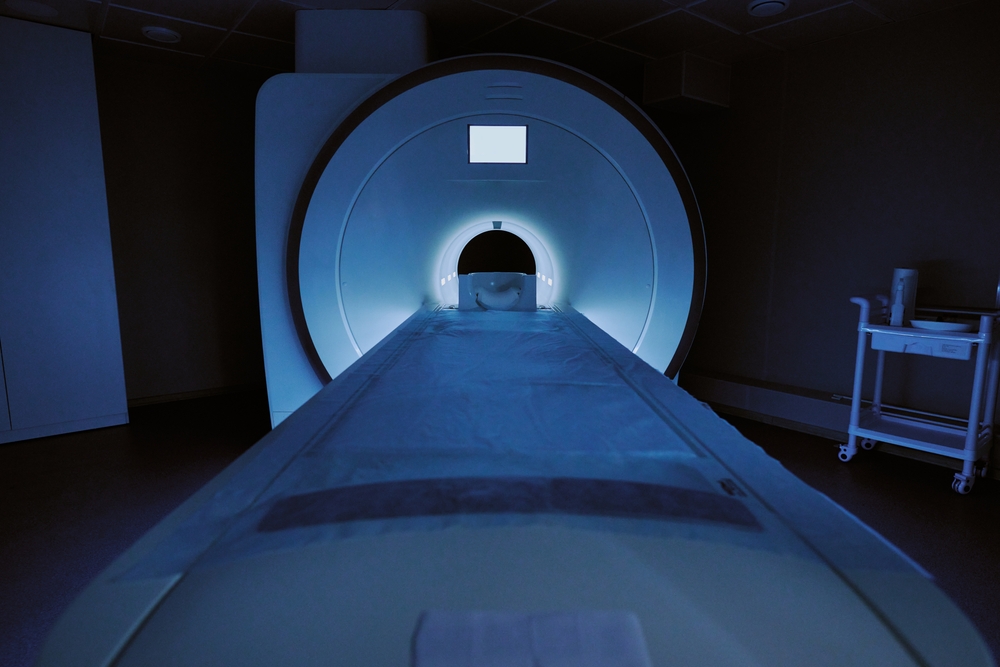
After safety screening, a technologist positions you on a movable table that slides into the scanner. A device called a coil may be placed around the body area being examined to help collect the signals used to form images. If contrast is needed, the team may place an IV in your arm or hand.
The scanner makes loud tapping and knocking sounds. You will receive hearing protection and instructions about remaining still. Depending on the examination, you may also be asked to hold your breath briefly. The technologist monitors you and can communicate with you during the scan.
MRI itself is generally painless, although lying in one position can be uncomfortable. Tell the technologist if you experience pain or need help. Movement can blur images and require some sequences to be repeated.
How Long Does an MRI Take
Many MRI examinations take roughly 15 to 60 minutes, and some take longer. The body area, number of imaging sequences, contrast use and need to repeat images all affect the timing. Ask the team for an estimate for your specific scan.
Allow additional time for check-in, screening, changing and any IV preparation. Your time inside the scanner is only one part of the appointment. If you are traveling or arranging transportation, confirm the expected total visit length when scheduling.
What If You Have Claustrophobia?
Tell the team before your appointment if enclosed spaces cause anxiety or if you previously had difficulty completing an MRI.
Discuss the scanner configuration, positioning and comfort measures that may help. Ask whether an open or less enclosed scanner is available and appropriate for the examination your provider ordered.
Your clinician may recommend medication when appropriate. If you receive a sedative, follow the medication and discharge instructions and arrange for someone to drive you home. Planning ahead gives the team time to discuss a suitable approach.
What Happens After an MRI and When Will Results Be Ready?
After a routine MRI without sedation, most patients can resume normal activities unless given other instructions. A radiologist reviews the images and prepares a report for the referring healthcare provider. The technologist taking the images generally does not provide the final interpretation.
Reports may be available within a few days, but timing depends on the examination, urgency and facility workflow. Ask when the report is expected, who will contact you and how to request your images. Mayo Clinic’s MRI overview also explains the role of the radiologist and follow-up with your provider.
Your provider will explain what the findings mean and whether you need monitoring, treatment, another test or a specialist consultation. If you have not heard back within the expected timeframe, contact the referring office. Seek prompt medical advice for urgent or worsening symptoms rather than waiting for a routine report.
Planning an MRI Visit From Maryland, West Virginia or Virginia
If you are researching MRI options from Frederick, Columbia, Eldersburg, Owings Mills, Reisterstown or Westminster, Maryland, confirm the actual imaging address before booking. The same applies if you are looking from Charles Town, West Virginia, or Winchester, Virginia.
ADR’s office is located at 952 Seton Drive, Suite 210, Cumberland, MD 21502. Contact our team to confirm that we offer the examination you need and to discuss appointment availability before making travel arrangements. Review our insurance and billing information and ask your insurer about network status, authorization requirements and your expected out-of-pocket costs.
Frequently Asked Questions About MRI
Does every MRI need contrast?
No. Contrast is used when it can help answer the clinical question. Your provider and radiology team determine whether it is appropriate for the examination and your health history.
Can I have an MRI with a joint replacement or pacemaker?
Possibly. Eligibility depends on the exact implant or device and the conditions required for scanning. Give the team device details in advance; never assume an implant is safe for MRI without review.
Can I eat before my MRI?
It depends on the examination and whether sedation is planned. Follow the imaging team’s instructions rather than applying preparation advice from a different scan.
Will I need someone to drive me home?
Usually not after a routine MRI without sedation, provided you feel well and have no other restrictions. If you receive a sedative, arrange a driver and follow your care team’s instructions.
Schedule an MRI at ADR in Cumberland
Ready to take the next step after an MRI referral? Call 301-777-3522 or contact Advanced Diagnostic Radiology to discuss scheduling, preparation and the examination your provider ordered.
Our team can help you confirm the details before your visit to our Cumberland office.